Okay, I have something to admit: I was a theater kid.
**Opening scene:** A skinny twig of a lad wanders backstage for his first casting call. His eyes are brimming with anxiety, and his heart is fully open to adventure. Little did he know that he would come to love the smell of the theater—the musty, dusty backstage filled with decades of props and tears. He would go on to perform in front of hundreds of local moms and dads. It wasn’t long before he realized his true passion was directing, reveling in all of the core components: the building blocks of narrative, lighting design, set design, understanding motivation, and manipulating dramatic cues, all these elements leading up to the big show. As time passed, the kid grew into a young man. Still skinny, though that affliction had long passed, he hungered for new ways to apply his creativity: at first, graphic design; then logo design; then identity systems; studying HCI, eventually emerging into a career in UX. Although it felt like a distant memory, theater never left him.
Okay, okay—drama aside. As I entered this new stage of UX theory and learned a new language: components centered around users’ needs and behaviors, user journeys, user flows, mind maps, personas, journey mapping, the mind reels! I remember in my formative years, my first lessons in constructing an experience and how to communicate to clients. I found myself exploring ways to translate our discipline to people outside our troop. We impressed upon our business partners that you couldn’t build a house without blueprints, and while they weren’t actual designs, they were essential—a concept clients are still unsure about to this day. But blueprints? UX was so much more, filled with new ways of doing things and still evolving.
Working with my fellow UX colleagues, I realized just how much the language and mechanics of the theater were imprinted on me. I wasn’t as outright analytical as my design counterparts; I needed more context. I needed to know where the entrances and exits lead. I needed to know the scene. The way I approached my process was much like directing a play. The way I saw objects, elements, and interactions was meant to be orchestrated, not merely placed according to the laws of Jacobs or Hicks. I envisioned a picture that allowed me to meld this way of thinking, to add a sense of storytelling to my discipline of UX, and my role within marketing and advertising.
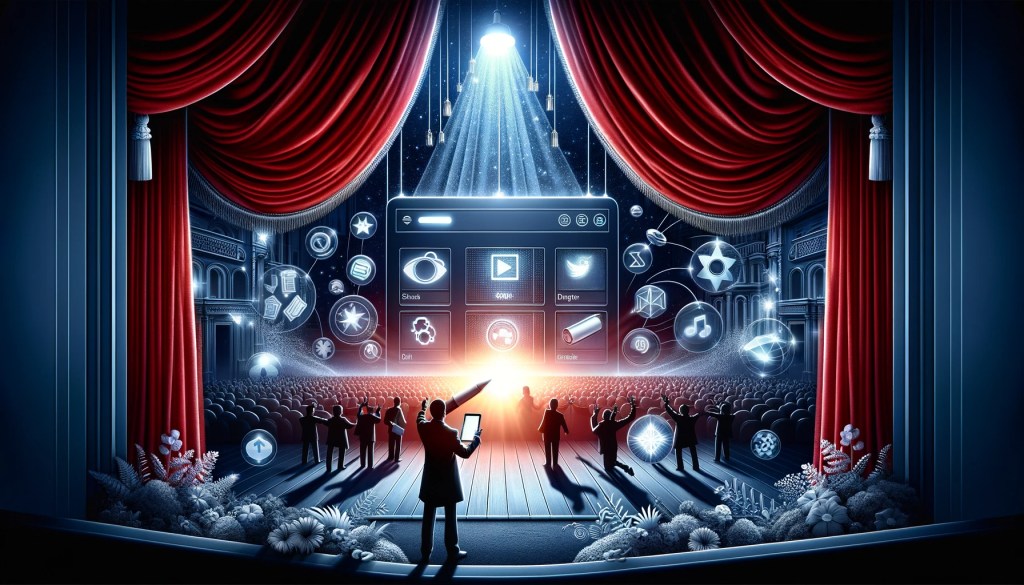
Imagine the user interface as a stage. This stage, crafted with meticulous design and structure, lays the groundwork where our UX components each have a part to play. Just as in theater, where the stage’s setting profoundly influences the unfolding drama, in UX, the layout and visual hierarchy shape how users engage with the application. A well-crafted stage ushers the audience’s gaze effortlessly, spotlighting pivotal moments. Likewise, in UX, a skillfully designed interface shepherds users through their journey, making vital features effortlessly accessible and easing cognitive strain. The stage’s ambiance, painted with color schemes and typography, sets the emotional tone, swaying users’ feelings and reactions, akin to how a theater’s atmosphere captivates its audience.
Enter the actors—the UX elements like buttons, menus, icons, and images, each bearing a distinct role and intent, reminiscent of actors in a play. A button, perhaps, as the protagonist, compelling the user towards action with prompts like ‘buy now’ or ‘learn more’. Menus and navigation bars, the supporting cast, escort the user across the digital terrain. Icons, our character actors, offer quick, visual shorthand that boosts comprehension and engagement.
Just as actors weave together a narrative through their interactions on stage, these UX components harmonize. Their interplay guides the user’s expedition, crafting a rhythm that’s intuitive and fluid. A shift in one element—like a button’s relocation or masterful typography—echoes an actor’s stride across the stage, redirecting the user’s focus and the narrative’s trajectory. This vibrant interplay breathes life into the user experience, making it resonate and enthrall.
UX designers, in no small part, step into the director’s shoes, choreographing the spectacle on the digital stage. Much like a director maps out the play’s rhythm, positions the actors, and signals their entrances and exits, UX designers intricately plot the user’s pathway. They dictate which elements lead at given junctures, how they interact, and when they emerge to ensure the narrative unfolds with coherence and allure.
A pivotal facet of a UX designer’s craft is in understanding the audience—our users. This entails delving into and empathizing with their needs, preferences, and constraints, mirroring how a director must grasp the audience’s anticipations and sentiments. Designers leverage this insight to synchronize the UX elements, ensuring they concert in harmony to forge experiences that
are not merely functional but also enchanting.
By perpetually testing and refining, UX designers fine-tune the performance, tweaking how elements mesh and flow to polish the user’s experience. This iterative method is vital in heeding user feedback and adapting to evolving demands, guaranteeing that the digital experience stays pertinent and captivating.
Viewing UX components as actors on a stage surrounded by motion and feedback unfurls a novel lens on digital experience design. For me, this overlay enriches our understanding of user interaction and the significance of each component’s role in sculpting the overarching story. Just as a successful play demands a symphonic blend of actors, stagecraft, and direction, effective UX design hinges on the deliberate integration of elements, copy, layout, and user navigation.
As I see a new generation coming into the profession filled with PhDs and a head full of theory, I always invite them to infuse their design with creativity and empathy, drawing from their own personal experiences outside of UX. This approach invites us to craft more immersive, intuitive, and memorable user experiences. So, the next time you’re designing or refining a user interface, remember this—ponder on your actors’ performance and how you, as the director, can maximize their potential to captivate your audience. How might you envision your relationship with theory and make it reality?
 Jason Milano | Seasoned UX Leader
Leave a comment